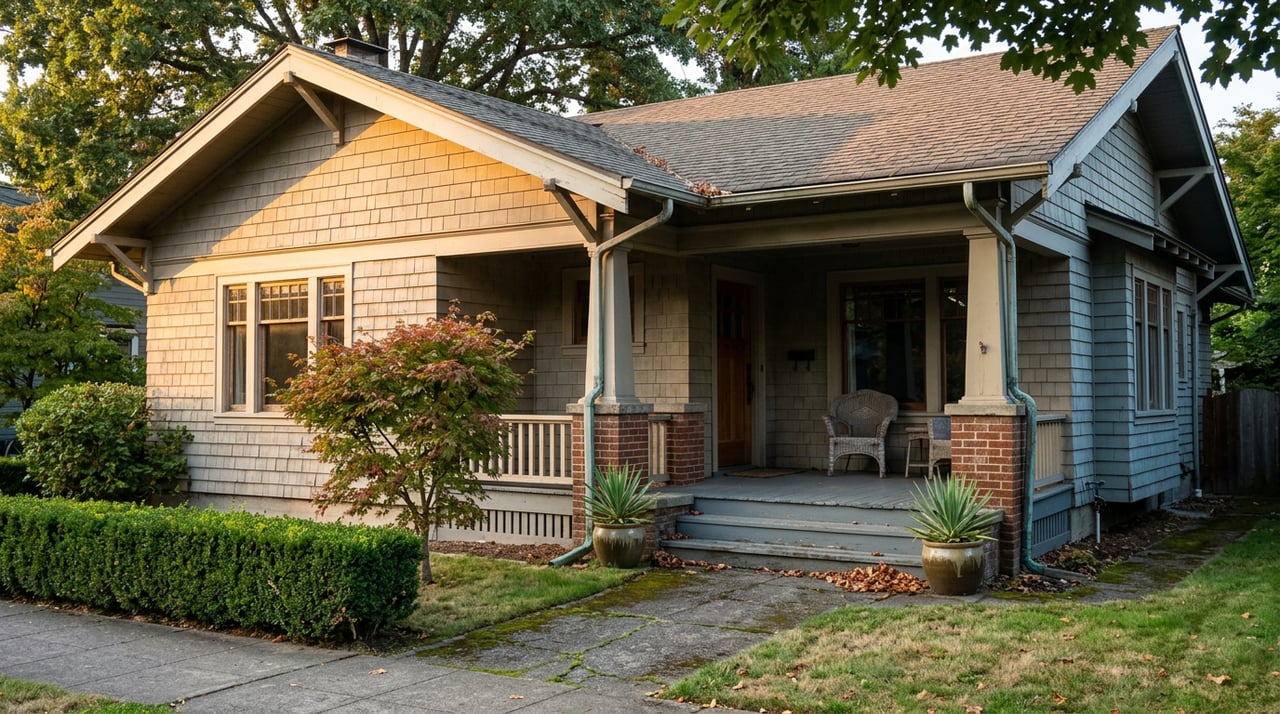
Most sellers in Vinegar Hill assume two things go together: their home sits inside a recognized historic district, so of course it carries a property tax break too. Walk the blocks south of downtown San Pedro and it's easy to see why the assumption holds. Vinegar Hill's houses were built between 1886 and 1927 by the businessmen who ran early San Pedro, and the streets still carry a working mix of Queen Anne, American Foursquare, Craftsman, and later American Colonial and Spanish Colonial Revival styles. The Vinegar Hill Historic Preservation Overlay Zone, adopted by the city in 2001, protects that mix.
Here's the part that trips people up during a sale. Being a contributing structure in that HPOZ and holding a Mills Act tax contract are two completely separate pieces of paper, administered by two different offices, and one of them is worth real money while the other one isn't. A house can be one without the other. Confusing the two is where sellers either leave value on the table or stumble into a disclosure problem they didn't see coming.
The HPOZ designation is a planning tool. It tells you what review your exterior work needs before you touch the house. In Los Angeles, that review splits into two tracks: routine maintenance and small changes get processed as Conforming Work, often with no application fee, while additions, roofline changes, or anything altering visible massing require a full Certificate of Appropriateness through the city's Office of Historic Resources. Neither track has anything to do with your tax bill.
The Mills Act is a different animal entirely. It's a recorded contract between a property owner and the city, authorized under state law since 1972, in which the owner commits to maintaining the historic character of the building in exchange for having the county assessor calculate property taxes using an income-capitalization method instead of the standard Proposition 13 factored value. To even qualify, a single-family property's pre-contract assessed value has to sit at or below $1.5 million, and the owner still has to apply, get a staff review, and secure sign-off from the city's Cultural Heritage Commission. None of that happens automatically just because a house sits inside Vinegar Hill's boundary.
The gap between these two boxes shows up clearly in a Vinegar Hill filing I came across while researching this piece: the Harbor View House at 921 South Beacon Street, a five-story 1926 Mediterranean Revival building that started life as the Army and Navy YMCA. It's a designated Los Angeles Historic-Cultural Monument and a contributor to the Vinegar Hill HPOZ, with a current assessed value around $9.5 million, well above the standard cap. City staff had to grant it a specific exemption from the valuation limit before a Mills Act contract could even be considered. That's a commercial-scale example, not a typical bungalow, but it makes the mechanism visible: designation and tax contract are decided on separate tracks, with separate thresholds, and neither one guarantees the other.
When a Mills Act contract does exist on a property, the numbers matter enough to change how a listing should be marketed. Property tax savings for participating owners in Los Angeles typically run 30 percent to 60 percent a year, calculated by the county assessor using the property's income potential rather than its recent sale price or Prop 13 base year value, whichever comes out lowest. And the contract doesn't expire at closing. It's recorded on title, it transfers automatically to whoever buys the house, and the buyer inherits both the reduced tax bill and the maintenance obligations for the rest of the term. Contracts run on a rolling 10-year cycle that renews every year unless either the city or the owner files a non-renewal notice, so in practice they stay in place indefinitely.
That transferability is the reason this is a selling point worth naming specifically, not folding into a generic "historic charm" line in the listing description. A verified Mills Act contract is a quantifiable, transferable financial benefit. A verified HPOZ contributing designation, on its own, is not.
There's also a fresh wrinkle worth flagging if the contract in question is relatively new. The Los Angeles City Council approved an updated Mills Act fee structure on December 20, 2025, and it took effect February 23, 2026. The new annual administration fee applies to contracts recorded since 2014, which covers roughly 246 properties citywide. If a Vinegar Hill listing carries one of those newer contracts, that annual fee needs to be part of the numbers a buyer's lender sees, not a surprise that surfaces mid-escrow.
California's Transfer Disclosure Statement, required under Civil Code Section 1102 for one-to-four-unit residential sales, asks sellers to state whether the property is historically designated or sits inside a historic district. Checking that box is the minimum, not the finish line. A seller who checks it without explaining what the designation actually means for renovation limits, review timelines, and tax treatment going forward hasn't really disclosed anything. If a buyer later argues they didn't understand what they signed up for, the seller can face a rescission claim, and in cases where the omission looks intentional, a fraud claim under Civil Code Section 1710.
The practical fix is straightforward. Before a Vinegar Hill property goes on the market, someone needs to confirm two separate facts and write them into the disclosure narrative in plain language: first, whether the house is a Contributing or Non-Contributing structure in the HPOZ, which can be checked through the city's ZIMAS mapping tool, and second, whether a Mills Act contract is actually recorded against the parcel, which shows up in county assessor and recorder records. Sellers and agents who treat these as one fact instead of two are the ones who end up explaining a gap during escrow instead of before it.
There's a second layer worth knowing about before scheduling any pre-listing work. San Pedro's community plan overlay may require its own planning clearance, separate from HPOZ review, before permits are issued for demolition, additions, exterior alterations, fences and walls, signs, grading, or certain changes of use in covered areas. If a seller schedules new siding or a fence repair the week before photos without checking whether the parcel needs that clearance first, the fix can turn into a delay that pushes the listing date back. Given that homes in San Pedro's tighter submarkets have been going from list to contract in about a month this year, according to closed-sale data tracked through August 2026, a week or two of avoidable delay on a Vinegar Hill listing is not a small thing.
San Pedro's overall market has cooled into something closer to balanced this year, with closed sales tracked through August 2026 showing a median price around $790,000 citywide and homes typically moving from listing to contract in roughly a month when priced correctly. In that kind of market, precision matters more than volume. A Vinegar Hill listing that names its HPOZ status accurately, verifies whether a Mills Act contract actually exists, and explains both clearly to a buyer isn't just avoiding a legal headache. It's showing up with the one piece of paperwork that competing listings in the same district might be missing entirely.
If you own a historic property in Vinegar Hill and aren't sure which of these boxes actually apply to your house, that's exactly the kind of question worth answering before a sign goes in the yard. Selling San Pedro has spent decades reading this neighborhood block by block, and can help you sort out what's actually recorded on your title before a buyer's agent finds it first.
What's your home worth?
Does every historic-looking home in Vinegar Hill have a Mills Act contract? No. Contributing status in the HPOZ is a planning designation tied to the district as a whole. A Mills Act contract is a separate, individually filed agreement, and plenty of contributing homes never applied for one.
Can I apply for a new Mills Act contract on a Vinegar Hill property right now? The city has not been accepting new contracts since its 2020 program assessment, and draft policy updates were released in 2025 as part of an effort to revive and restructure the program. Check current status directly with the city's Office of Historic Resources before assuming you can enroll.
If I buy a house with an existing Mills Act contract, can I get out of the maintenance obligations? No. The contract transfers with the property, and the new owner takes on the remaining term along with the tax benefit. Violating the terms, such as replacing historic windows with non-conforming materials, can lead the city to cancel the contract and pursue back taxes.
Does HPOZ designation hurt resale value? The city's own materials note that homes in historic districts have tended to appreciate at rates comparable to or higher than similar homes outside those districts, though any individual sale depends on condition, pricing, and the buyer pool at the time.
Browse active listings in the area or contact us for off-market listings.
Have an expert help you find out what your home is really worth.
Gary has a true passion for the real estate business and prides himself on staying up to date on current market conditions, latest real estate trends, and innovation that can help him and his clients to be more successful when working together.